

Comparison / The research library
Really Good Emails vs PromoStash: inspiration or your own archive?
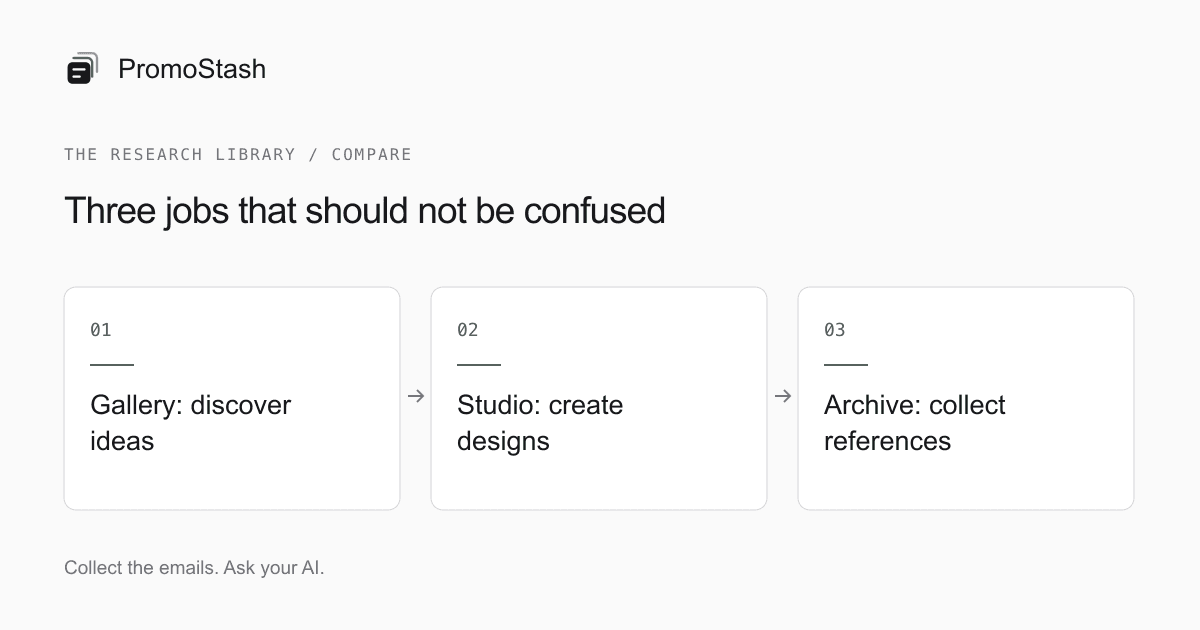
Really Good Emails and PromoStash solve different parts of email research. RGE’s gallery helps you discover curated examples, and RGE Studio supports email creation. PromoStash collects your chosen subscriptions in a private archive. Pick the workflow you need—discover, create, or collect—before looking for a like-for-like alternative.
Published by PromoStash. Official-source comparison; not an independent product review. How we write comparisons
On this page
Separate the RGE gallery from RGE Studio
Really Good Emails’ official about page (opens in a new tab) describes a curated gallery and community alongside RGE Studio, its email-creation product. Treating all of that as a static screenshot directory would miss the current offering. It would also make an unfair comparison with an archive that deliberately does not create emails.
PromoStash is narrower. A user subscribes with a private address, emails arrive in that account, and the user browses, searches, or adds them to manual collections. A compatible AI client can read the archive through MCP. There is no visual builder, approval workflow, email export-to-ESP pipeline, or sending interface.
Choose among discovery, creation, and capture
| Need | Relevant starting point | Why |
|---|---|---|
| Find unfamiliar design references | RGE gallery | Curated examples can broaden your reference set |
| Build an email from a design workflow | RGE Studio | Creation is part of the product’s stated purpose |
| Keep newsletters sent to your own address | PromoStash | Private capture preserves your selected source set |
| Read a captured archive from an AI client | PromoStash MCP | Search and retrieval, plus optional collection organization |
| Work on Studio designs from an AI client | RGE Studio MCP beta | Design actions, rather than this private inbox workflow |
These are workflow fits, not quality ratings. A designer can discover a reference in one place, maintain a subscription history elsewhere, and create the actual email in a third tool. You do not need one application to own every step for the process to be coherent.
When curated inspiration is what you need
If your question is ‘What are some different ways to present this message?’, discovery may be the right first step. A curated source can introduce unfamiliar layouts, categories, and senders. You are not limited to the subscriptions you remembered to collect before the project started.
Choose a small set of contrasting references. Put a minimal text-led message beside an image-heavy one, or compare how different examples introduce the first action. Write down which visible decisions are relevant to your brief. That is more useful than saving every attractive page and hoping the collection will explain itself later.
Curation is a selection process, not a record of every ordinary message a sender delivers. That is neither a defect nor a guarantee of performance; it is a different source boundary. If you want the sequence around a particular announcement, a recipient’s ongoing archive can complement the selected examples you discover in a gallery.
For broader catalog research, our Milled vs PromoStash comparison looks at an existing email search engine versus private capture. That may be a more relevant decision if your priority is looking across a known category and date range rather than studying design references.
When your own captured history matters more
A private archive fits when you want to follow the messages reaching a selected address over time. You choose the newsletters or accounts, capture what arrives, and keep a chronological reference. This includes the ordinary reminders and repeated explanations you might not put in a curated design board.
That history is useful for questions about sequence: what arrived before an announcement, how a sender introduced a first step, or which explanation accompanied a reminder. You still need to acknowledge missing periods and recipient-specific targeting. Capturing one subscription does not reveal all customer segments or prove why a sender made a decision.
PromoStash groups by sender domain and lets you curate collections manually. A collection is a selection from your saved messages, not an automatically generated campaign category. The email swipe-file guide explains how to keep brand history and brief-specific curation working together without a complicated taxonomy.
If you only have a few references and Gmail already makes them easy to find, a separate product might not be necessary. Our Gmail swipe-file comparison describes that simpler starting point. Choose the archive because its boundaries help you, not because a comparison page suggests every marketer needs another app.
RGE also has MCP. The useful question is what it does
RGE Studio’s official MCP beta page (opens in a new tab) describes finding, creating, updating, previewing, saving, and exporting Studio designs from compatible AI tools. Its stated purpose is design work. PromoStash’s MCP connection instead searches and retrieves your captured emails, brands, and collections; it does not create or update campaigns.
This distinction matters more than a checkmark labelled ‘AI integration.’ A connection to a creation workspace can operate on designs. An archive connection provides reference material and, with explicit write permission, can organize collections. Decide which action you want, then inspect the authentication, permissions, and source material exposed by that specific connection.
- For research: ask which saved messages the client can retrieve and whether the response identifies its sources.
- For creation: ask what actions can change designs and how you review those changes.
- For either: inspect the client’s own plan requirements and data-handling settings.
- Do not assume that sharing a collection name limits the connection to only that collection.
PromoStash does not add its own AI subscription or credit system, but using an external client remains subject to that client’s requirements. A useful research prompt asks for a narrow set of messages and visible evidence. Avoid treating either an archive or an AI response as an independent validation of campaign performance.
Evaluate the plan for the part of the workflow you need
PromoStash’s current Free plan includes 3 tracked brands, 100 emails, 3 manual collections, and MCP. Pro is $9/month or $29/year at the founding price, locked while the subscription stays active. Pro adds forwarding and file imports, subject to the current limits.
For RGE, check the current terms of the specific offering you intend to use: the gallery, Studio, or an integration. We do not reduce those different offerings to a single unverified price or suggest that a lower archive price replaces a design workspace. The relevant cost is the one attached to your actual task.
Consider the work outside the subscription too. A private archive needs source selection and time to accumulate history. A gallery still requires thoughtful reference selection. A creation tool still requires review of the email you plan to send. None of those responsibilities disappears because a plan includes an integration.
A simple way to use discovery and capture together
- Use a public gallery to find a few approaches relevant to the current brief.
- Write down which visible choices you want to understand, not just which layouts you like.
- Subscribe to selected senders when you want an ongoing recipient history.
- Keep the captured messages in a small, purposeful collection.
- Develop and test your own email in your creation and sending tools.
If the useful history is already in Gmail, our EML and MBOX import guide covers bringing selected messages into PromoStash Pro. There is no direct RGE gallery or Studio collection import, and the archive should not be described as synchronizing material from either product.
The result is a clear division of responsibilities: discovery for new references, capture for a source set you choose, and creation for your own work. A fair alternative is one that fits the part you want to change, not one that claims to replace everything with a shorter feature list.
Common questions
Is PromoStash an email builder like RGE Studio?
No. PromoStash collects and retrieves marketing emails. It does not create templates, edit campaigns, or send email.
Does Really Good Emails offer MCP?
RGE Studio publicly documents an MCP beta for design actions. PromoStash’s connection reads a captured research archive and can organize collections with explicit write permission. Check each provider’s current setup and terms.
Can I browse a public inspiration gallery inside PromoStash?
No. A PromoStash account contains messages received or imported into that private archive. It does not include a prepopulated public gallery.
Sources and editorial notes
Public sources checked September 6, 2026. Product interfaces and terms can change. PromoStash features and limits were checked against this application’s implementation.
- Really Good Emails: about the gallery and Studio (opens in a new tab)
- RGE Studio: email MCP server beta (opens in a new tab)