

Comparison / The research library
Milled vs PromoStash: discovery library or private archive?
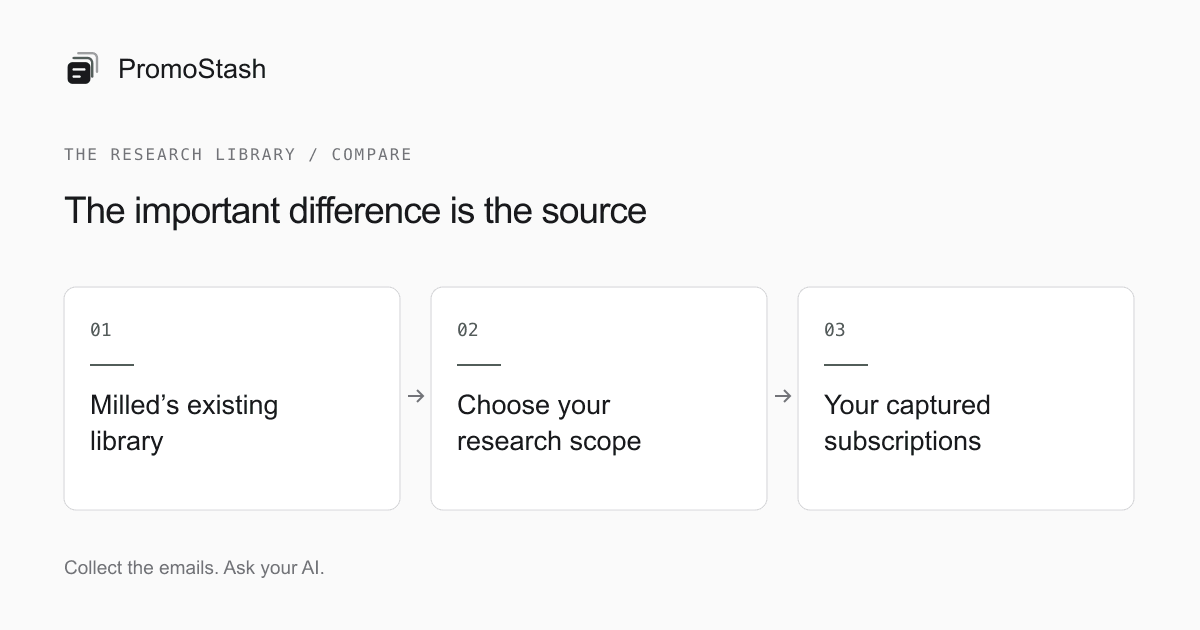
PromoStash is a Milled alternative for a private email archive, not a replacement for Milled’s existing discovery library. Choose based on the source material you need: emails already available in a public search engine, or messages collected from your own subscriptions. Many research workflows benefit from both.
Published by PromoStash. Official-source comparison; not an independent product review. How we write comparisons
On this page
Start with the material you need to find
Milled describes itself as a search engine for ecommerce emails. Its official product page (opens in a new tab) presents an existing searchable catalog. That is useful when you want examples now, before you have built your own history. A private capture inbox serves a different need: preserving the messages that actually reach your selected address.
PromoStash starts with your subscriptions and imports. It does not retrieve Milled’s catalog, scrape competitor websites, or fetch an arbitrary brand’s historical emails on demand. Searching for a brand in a new PromoStash account will not produce a back catalog unless you have already collected or imported those messages.
Public discovery and private capture, side by side
| Research task | Milled | PromoStash |
|---|---|---|
| Find examples before subscribing | Search its existing catalog | Import messages you have, or begin collecting |
| Study your own recipient history | Catalog reflects Milled’s available material | Study messages captured at your address |
| Save and organize examples | Saved emails; Pro collections and private notes | Manual collections within your private archive |
| Browse earlier history | Back-catalog access varies by plan | History is limited to what you captured or imported |
| Use PromoStash’s scoped MCP tools | Not the subject of this integration | Search and retrieve your archive with a compatible client |
| Write or send a campaign in PromoStash | Outside this archive comparison | Not provided |
Milled’s current plan comparison (opens in a new tab) includes saved emails on Basic and collections, private notes, and full-archive access on Pro. It would be inaccurate to describe Milled as having no organization features. The difference here is the collection’s source and the surrounding workflow, not whether saving an email is possible.
When Milled is the more direct starting point
Suppose you need a set of ecommerce promotion references for a brief due today. You have not been collecting that category and do not have an old mailbox export. Starting a private subscription now cannot produce last season’s history. An existing library is a more direct place to look, subject to the brands, dates, and access available there.
The same applies when discovery is the work: you know the type of promotion you want to study but have not chosen the brands. Beginning with a catalog can help you identify candidate senders. A private archive can then follow the ones that become relevant to your ongoing projects.
- Start with discovery when your source set is unknown.
- Start with an existing library when your own archive does not cover the period you need.
- Inspect actual examples before assuming a catalog contains your niche or region.
- Keep the source URL and date beside any observation you use in a brief.
A catalog is not proof that you have seen every variation a brand sent. Ask the same questions you would ask of a personal archive: what dates are represented, which recipient context is visible, and what is outside the sample? A larger source pool changes your options, but it does not remove the need to bound a conclusion.
When a private archive is the better fit
Choose a private archive when you know which subscriptions matter and want them kept together over time. That might be a handful of newsletters in a specialized industry, the onboarding messages sent to your own account, or marketing mail you already have permission to collect. Your choices determine the source set instead of a public library’s coverage.
PromoStash keeps that source set separate from everyday correspondence. It groups arrivals by sender domain, offers text search and date filters, and lets you curate manual collections across brands. It does not assign competitor scores, identify campaign strategy automatically, or produce a weekly intelligence report.
For a practical starting structure, use the email swipe-file guide. If your current source is an ordinary mailbox, the Gmail comparison can help you decide whether a separate archive adds enough value to justify changing the habit.
Private does not mean invisible to every service involved in delivery and storage. It means your archive is account-scoped rather than a public gallery. If you connect an external AI tool, you authorize it to retrieve content. Keep confidential correspondence outside the research workflow and review the connected provider’s data settings.
Compare MCP by what it can access and do
PromoStash’s MCP tools can search emails, retrieve a message, list brands and collections, and retrieve bounded sets from them. With explicit permission, a client can also create, update, and delete collections and manage their membership. The compatible AI client does the interpretation. There is no built-in summary, writer, or analysis panel in the archive itself.
We are not claiming that Milled lacks all AI integrations. The public pages reviewed for this comparison establish its archive and organization features, not an exhaustive integration inventory. If an integration is decisive for your purchase, verify its current availability, authentication, and permissions directly with the provider.
Also distinguish research access from creation access. The Really Good Emails comparison explains RGE Studio’s publicly documented MCP beta and why a design-oriented connection is a different workflow from reading captured newsletters. The letters ‘MCP’ alone do not tell you which material a client can see or which actions it can take.
Compare current plans without a misleading price contest
PromoStash Free provides 3 brands, 100 emails, 3 collections, and MCP. Pro offers 25 brands and 5,000 stored emails, plus forwarding and imports. It costs $9/month or $29/year at the founding price, locked while the subscription remains active.
Milled sells access to an existing catalog and its research features; PromoStash sells capacity and tools for a privately collected archive. Those are different contracts. We link Milled’s live pricing page rather than presenting an ambiguous monthly-equivalent figure from a partially rendered pricing toggle as a fixed current price.
Check the plan against your research period, the examples you can actually access, and the workflow you will repeat. A low subscription price is not useful if the tool cannot provide the source material you need today. Equally, a broad public catalog may not replace a narrow recipient-specific archive you need to build over time.
Try one research question before moving your workflow
- Choose a concrete question and a date range, such as how selected brands explain a seasonal offer.
- Check whether the public catalog contains useful references for that range.
- Start collecting the few subscriptions you expect to revisit regularly.
- Keep a collection of examples tied to the same brief, with source dates visible.
- Compare the usefulness of the references, not just the number of search results.
If you decide to build the private side, follow the competitor-email capture guide. You do not need to stop using an inspiration library. A sensible division is discovery for unfamiliar examples and private capture for a chosen ongoing source set.
Common questions
Can PromoStash import my Milled saved folders?
There is no direct Milled import or folder-sync integration. PromoStash Pro accepts supported EML and MBOX files you already have; it does not extract Milled’s catalog.
Does Milled support private notes and collections?
Yes. Milled’s public Pro feature table lists collections and private notes. This comparison distinguishes a public catalog from private capture, not organized versus unorganized email.
Can I use both tools?
Yes. Use a public library for discovery and a private archive for subscriptions you want to follow. Keep the boundaries of each source set clear in your research.
Sources and editorial notes
Public sources checked September 6, 2026. Product interfaces and terms can change. PromoStash features and limits were checked against this application’s implementation.
- Milled: official product overview (opens in a new tab)
- Milled: plans and feature comparison (opens in a new tab)